Love Thy Neighbor
In a previous post – "Courage Before Discipline" – I pointed out that there are three parts to Ryan Holiday's book, Courage is Calling: Fortune Favors the Brave:
- Part I: Fear
- Part II: Courage
- Part III: The Heroic
In the previous post – "Agency is an Effective Truth" – I addressed Part I, choosing to focus on two chapters:
- Agency is an effective truth
- We are afraid to believe
In this post, I address Part II, again choosing to focus on two chapters:
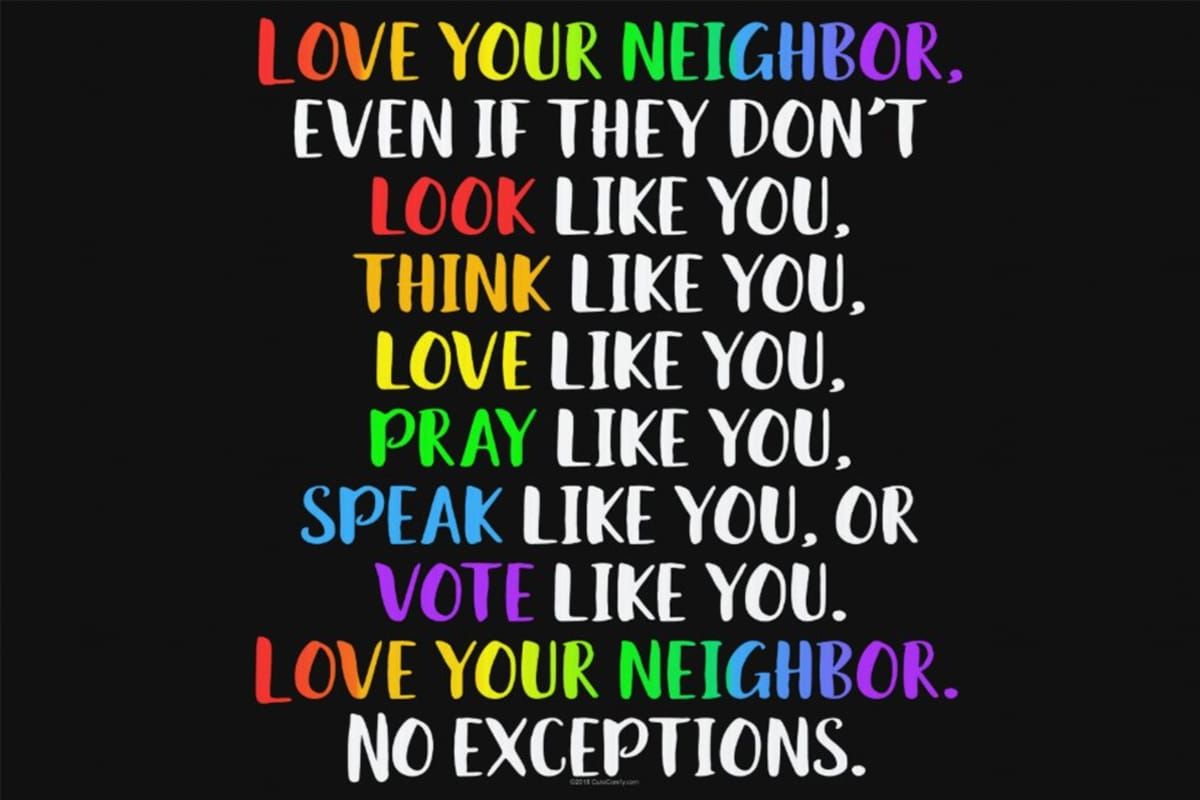
- Love Thy Neighbor
- If Not You, Then Who?
Ryan Holiday begins "Love Thy Neighbor" by sharing a well-known story:
At 3 a.m. on March 13, 1964, a young woman named Kitty Genovese was brutally raped and stabbed outside her apartment building. As she cried for help, she was ignored. As the sounds of her murder reverberated through her neighborhood, more than three dozen people turned up their televisions, turned over in bed, or decided it didn't concern them.
Why? Fear. Selfishness. Alienation. Maybe they thought someone else would do something. Maybe they didn't believe they could do anything. The cowardice and indifference of the community allowed a serial rapist and muderer so much cover that he returned to steal fifty dollars from the victim's purse.
What would we have done if we had been in our apartment that night? Would a year of 636 murders and our own busy lives have numbed us to the screams of a dying woman?
Although the story has come to represent all the ills of today's society, in truth one of Kitty's neighbors was not so far gone as the others. Actually, more than one. One neighbor, hearing the sounds, called Sophia Farrar, herself a young woman in the building, to say they thought Kitty was in trouble.
Without a thought for her own safety, Sophia, in her thirties with a baby at home, dressed quickly and rushed to the sound. There Kitty lay in front of the door to the building, wedging it shut. Carefully opening the door, Sophia found Kitty barely alive, soaked in her own blood, stabbed through the chest and lungs. Whispering sweetly to Kitty, Sophia tried desperately to save her life. She shouted until someone called the paramedics. She encouraged her neighbor to hang on, that help was coming. She told the dying woman that she was loved, that someone was there.
It was too late. Kitty bled out in the ambulance on the way to the hospital.
"I only hope that she knew it was me," Sophia would say, "that she wasn't alone."
Holiday goes on to share how Kitty and Sophia were close friends – neighbors helping each other out on a regular basis. He also shares how Sophia was not mentioned in the famous New York Times article, which emphasized the community's lack of response, and as a result missed the story within the story. Holiday's point is simple yet powerful: As a general rule, the wellspring of courage is love.
Another perspective on courage can be found in the other target chapter, "If Not You, Then Who?" For those of you who are familiar with Trust-Based Relational Intervention™ (TBRI™), you may have recognized this is part of the "TBRI Mantra" (which, by the way, was written long before I read Holiday's book!):

I will probably have more to say about the Mantra in subsequent posts, but for now I would like to (briefly) connect the Mantra to Stoic philosophy, using one of Holiday's earlier books, The Obstacle is the Way (Penguin, 2014). Based on a quote from Marcus Aurelius, Holiday divides The Obstacle is the Way into three parts, based on the three Stoic disciplines:
- The Discipline of Perception (including control of your emotions);
- The Discipline of Action (including iteration, as in solving for pattern);
- The Discipline of Will (including perseverance, and starting over, if necessary).
I think you can see the three Stoic disciplines embedded in the the TBRI Mantra. What I think I am trying to say is the TBRI Mantra shows us how to be courageous, for courage can only exist in the context of meeting someone's need.