The WilCo Story: Just the Facts, Ma'am
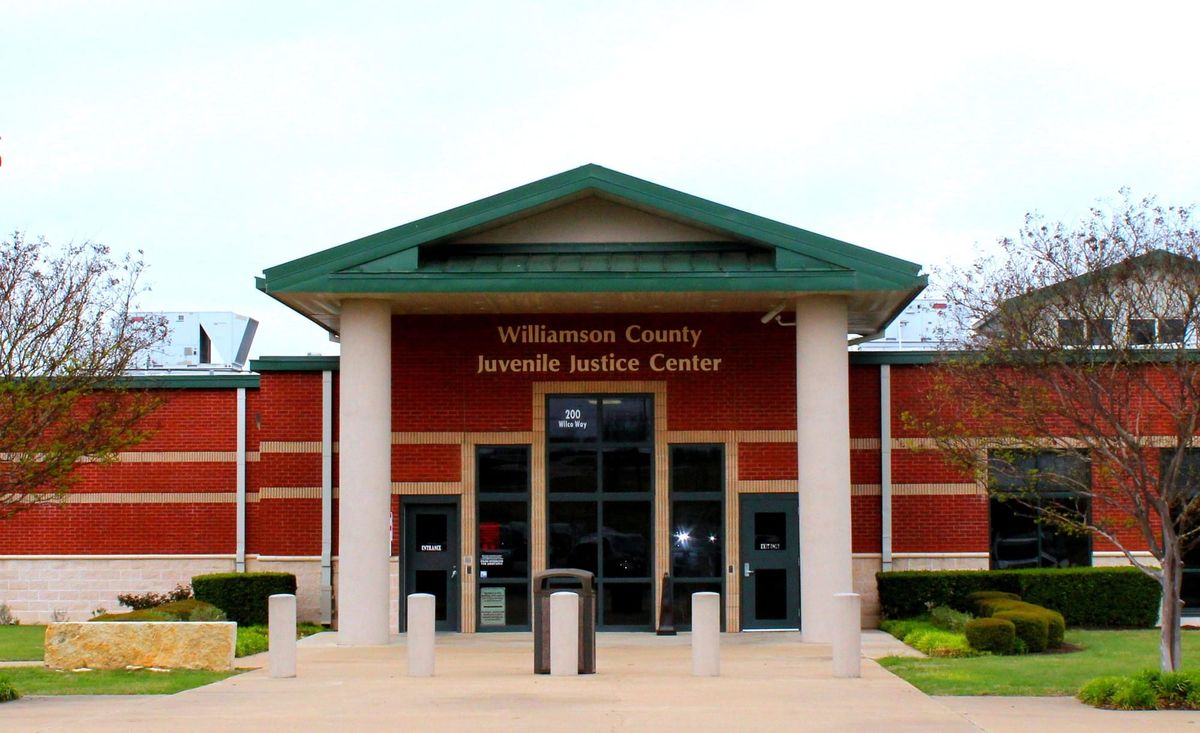
As I said in my previous post ("Here's the Plan"), I will share the "WilCo" story in three posts: (1) Just the Facts, Ma'am, (2) TBRI Practice Principles, (3) Cycles of Expansive Learning. This first post focuses on data, and is based on documents shared with me by Matt Smith, who was the primary change agent for this implementation of TBRI. What I share here sticks pretty closely to what appeared in my unpublished essay, "Solving for Pattern, Fourth Essay: A Case Study in Expansive Learning" (KPICD, 2020). This post will have three sections, as follows:
- The first section will be a telling of the TBRI® implementation story at Williamson County Juvenile Services (WCJS, or “WilCo”), where Matt Smith has been a key leader and change agent; this telling is based on information provided by Matt and his staff.
- The second section will be a pragmatic elaboration of the first section, that uses some of the “facts” of the “The WilCo Story” to illustrate the TBRI® Practice Principles, which were introduced in the first essay of "Solving for Pattern" series, under the guise of “Implementation Principles.”
- The third section will be a conceptual elaboration of “The WilCo Story,” viewed through the lens of Activity Theory and the Theory of Expansive Learning — much like what was done in analyzing Wendell Berry's account of Earl Spencer's Farm.
I will re-create the WilCo implementation story based primarily on the “TBRI® Implementation” document provided by Matt Smith; that document has four parts:
- TBRI® Implementation Timeline
- TBRI® Implementation Strategies
- TBRI® Implementation Outcomes
- TBRI® Training and Consulting
TBRI® Implementation Timeline
Summer 2016 WCJS adopted TBRI® as the trauma-informed framework for Juvenile Services; all staff were trained in summer 2016 through local nonprofit STARRY (a KPICD partner organization).
Summer 2016 A new partnership was formed with KPICD as WCJS is the first juvenile justice agency in the world seeking to implement TBRI® as an intervention framework; KPICD trainers presented a one-day TBRI® Overview for all WCJS supervisors and leadership during July in Georgetown, TX.
October 2016 KPICD trainers were on site to observe staff interventions with youth, interview staff, and assess overall culture in order to tailor a training specific to WCJS strengths and needs.
November 2016 STARRY Training Director and TBRI® Educator Jessica Kilpatrick trained 150 ISD and community professionals on “TBRI® in the Classroom” at the 2016 Williamson County Mental Health in the Schools Conference.
January 2017 KPICD trained all staff in a tailored TBRI® Overview for a juvenile justice setting.
January 2017 WCJS incorporates TBRI® for Teens (a training video) into new employee training.
March-April 2017 With funding support based on a partnership with the Travis County Collaborative for Children (TCCC), WCJS sent eight staff members to a week-long TBRI® Practitioner Training; these staff included a counselor, facility supervisors, direct-care staff, and a juvenile probation officer — trainees were selected in consultation with members of the KPICD Outreach Team.
Summer 2017 WCJS TBRI® Practitioners designed and executed a 2-day workshop and trained all staff during JSO/JPO summer training.
Summer 2017 WCJS changes all JSO and JPO job titles to “Youth Engagement Specialists” (YES) to emphasize the focus on youth engagement and improve recruitment of like-minded applicants; WCJS begins including “Core Beliefs” document as part of interview/hiring packet.
November 2017 In partnership with Williamson County District Judges Betsy Lambeth (family docket) and Stacey Mathews (juvenile docket), WCJS hosted 150 law enforcement, court, and legal professionals in a one-day TBRI® Overview as part of the First Annual Behavioral Health in the Legal and Justice Systems Conference in Williamson County.
January 2018 Juvenile Board Chair and Juvenile Judge Stacey Matthews begin requiring all attorneys requesting appointment to juvenile cases to first view the video recording of the TBRI® Overview training from the November 2018 conference.
March 2018 WCJS sent an additional four staff members to TBRI® Practitioner Training with the KPICD in Fort Worth; trainees included 2 probation officers, a detention supervisor, and a Family Preservation Supervisor.
June 2018 WCJS incorporates Howard Bath's “Three Pillars of Traumawise Care” framework as an overall department focus, and trains staff in the Three Pillars (the Three Pillars framework is complementary with TBRI®, and is introduced as part of the TBRI® Practitioner Training).
June 2019 WCJS sent an additional five staff members to TBRI® Practitioner Training in Houston (2 field counselors, detention supervisor, 2 field supervisors).
August 2019 WCJS implements the TBRI® framework as part of the Juvenile Justice Alternative Education Program (JJAEP); overhauls behavior management and youth engagement strategies using TBRI®.
TBRI® Implementation Strategies
- Ongoing TBRI® Champions meetings, addressing specific needs raised by staff, how to spread TBRI® throughout the organization, and provision of specific resources and tools.
- TBRI® emails to the entire department with reminders, resources, explanations, and encouragement.
- Nurture groups implemented as CORE Residential opens in March 2017; incorporation of new tools (fidgets, weighted blankets, other sensory tools), framework, and strategies — nurture groups are scheduled once per week in CORE.
- JSO and JPO titles changed to Youth Engagement Specialists (YES); TBRI® language added to job descriptions.
- TBRI® Problem-Solving worksheet implemented as a staff tool as a follow-up to critical incidents, as well as a proactive measure when youth and families appear resistant/disengaged — used in both residential and field services settings.
- TBRI® Practitioner and WCJS CORE Senior Supervisor Shannon Morning coaches staff using video replay of critical incidents.
- Critical Incident Review worksheet implemented using TBRI® Correcting Strategies — IDEAL Response and Levels of Response — to compare staff intervention with trauma-informed expectations.
- Calming Engagement plans implemented for individual CORE residents.
- Continued networking and support with TCCC partners.
- TBRI®-based parent groups; multi-family events for field programs focusing on relationship-building and TBRI® principles and strategies.
- Field Services begins tracking and measuring Sparks® and Developmental Relationships® as part of the TBRI® Connecting Principles and Strategies.
- Field Services begins hosting quarterly Family Nights focused on TBRI® Connecting Principles.
- TBRI® language/principles added to supervision policy.
- TBRI® Overview added to New Employee Orientation — training done by WCJS TBRI® Practitioners.
- Trauma-Informed Parenting Strategies (TIPS) class offered to parents — includes information on Adverse Childhood Experiences (ACEs), trauma-informed care, and TBRI® Principles and Strategies.
- One- and two-day TBRI® Workshops facilitated by WCJS TBRI® Practitioners are integrated into WCJS Summer Training for all employees..
TBRI® Implementation Outcomes
In 2017, WCJS staff conducted a 6-month follow-up comparison after TBRI® implementation by comparing CORE Residential Program (trauma-informed) with the Academy Program (traditional military structure):
- 83% decrease in youth grievances filed;
- 93% decrease in suicide watches;
- 31% decrease in physical restraints (accompanied by a decrease in duration);
- 45% increase in program completion;
- “Disciplinary seclusions” were replaced by “safety-based seclusions” — in effect, “disciplinary seclusions” dropped to zero.
WCJS Field Services also experienced a reduction in cases returned to court for violation of probation (see Figure 1).
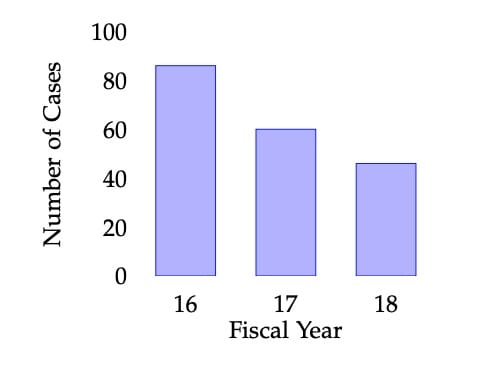
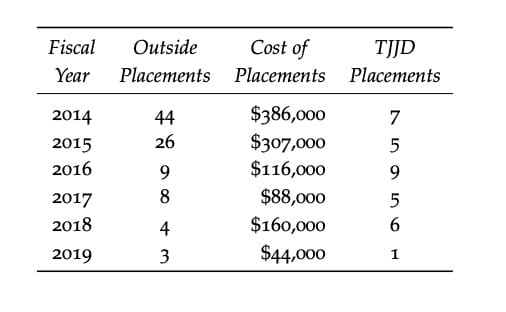
According to Matt Smith, the reduction in cases returned to court shown in Figure 1 is attributable to WCJS staff working more collaboratively with youth and families using TBRI® Principles and Strategies. In addition to the reduction of cases returned to court, WCJS also saw a reduction in outside residential placements, saving Williamson County substantial amounts in the cost of care (see Table 1).
TBRI® Training and Consulting
In partnership with the KPICD, WCJS assists other departments and organizations in understanding how to implement the TBRI® framework. The following agencies have attended WCJS TBRI® implementation workshops, tours, and meetings:
- Bexar County Juvenile Probation
- Grayson County Juvenile Probation
- Harris County Juvenile Probation
- Harris County Youth Collective
- Juvenile Justice Association of Texas (JJAT)
- Oklahoma County Juvenile Probation
- Tarrant County Juvenile Probation
- Texas Judicial Commission on Mental Health (JCMH)
- Texas Juvenile Justice Department (TJJD)
- Various agencies attending KPICD TBRI® Practitioner Training
As I said previously, this is the first of three blog posts on the WCJS (WilCo) TBRI® implementation story. The next blog post will re-tell the story, using the TBRI® Practice Principles as a guide. If you happen to be unfamiliar with TBRI® (Trust-Based Relational Intervention®), then I recommend you visit the KPICD website (child.tcu.edu), where you will find a variety of introductory resources, many of which are free.